Jenine Marquez
Product Designer
Helping caregivers understand incomplete meningitis vaccination
A new educational + risk assessment experience for PfizerForAll
Role: Senior UX/UI Designer
Team: 2 designers + 1 design lead, 1 content strategist, 1 copywriter, with Pfizer medical/legal review
Timeline: ~3 weeks (design) · March-April 2026
Live links: Meningitis overview page · Risk assessment quiz
Background
Overview
PfizerForAll is a consumer-facing digital health website that was recently relaunched by our team in January 2026, consolidating hundreds of Pfizer patient websites into one platform. PfizerForAll provides patients and caregivers a one-stop shop for health education and resources, including information about vaccines, COVID-19, migraines, and cancer. After the initial relaunch, more treatment areas were gradually added to the website, including meningococcal meningitis.
Meningococcal meningitis is a rare but severe bacterial disease that disproportionately affects teens and young adults. Most kids receive a first meningitis vaccine dose around age 11–12 that covers 4 types of meningococcal bacteria (A,C,W, and Y). However, a second dose covering additional bacterial strains is recommended around age 16, and it’s
frequently missed. As a result, nearly 85% of U.S. teens are not fully vaccinated against all five leading meningococcal serogroups (A, B, C, W, and Y), even though many of their parents believe vaccination is complete.
My team and I designed a new meningitis education and risk-assessment experience for PfizerForAll to close that awareness gap: helping caregivers understand what "full protection" actually means, assess their teen's risk in a few questions, and walk away with something concrete to bring to their next doctor's visit.
The Problem
Caregivers of teens aged 15–18 largely assume that if their kid got "the meningitis shot," they're covered. In reality:
Most teens only receive the MenACWY vaccine around age 11–12, and need a booster around 16 to stay protected against those four strains.
MenB is a separate vaccine entirely, recommended through shared clinical decision-making: a framework that can unintentionally signal to parents that it's optional rather than important.
The result is a large population of "partially protected" teens whose caregivers don't know they're partially protected.
Pfizer needed a way to raise awareness of this gap and motivate caregivers to have an informed conversation with their teen's doctor, without giving medical advice or promoting a specific Pfizer product over a competitor's.
Design Constraints
When designing a new educational meningococcal meningitis experience for PfizerForAll, there were some guardrails we had to follow:
Design for caregivers for teens and young adults who are eligible for the MenABCWY or MenB vaccination. All language, visuals and flows should assume this audience as primary.
No medical advice. The tool could assess risk factors, but never diagnose or recommend a specific vaccine or schedule.
No vaccination schedules. Given how variable and complex real-world recommendations are, the content had to consistently redirect caregivers to "talk to your teen's doctor" rather than attempt to explain dosing timelines itself.
No brand-driven promotion. The experience needed to stay manufacturer-agnostic and focus purely on motivating the conversation.
Stay consistent with existing PFA templates and experiences. Existing vaccine templates were already in place for RSV, pneumococcal pneumonia, COVID-19, and flu, so we had to stay within the general template of those vaccine pages to maintain consistency. There were also existing assessments for COVID-19 and migraine, so the meningococcal meningitis quiz had to work within existing functionality, with a downloadable PDF as the primary takeaway artifact.
Terminology precision. Meningococcal bacteria, meningococcal disease, meningitis, and meningococcal meningitis all mean slightly different things clinically, so the copy had to stay consistent and accurate throughout.
The Process
Competitive Research and Landscape
Our content strategist led an audit of Pfizer's existing unbranded meningitis site (meningitis.pfizer.com) against the client-provided PRD, plus three competitor experiences - meningitis.com (GSK), Bexsero, and Penmenvy - to see how the category talks about risk and urgency. The team worked from those findings to shape layout, hierarchy, and interaction design.
A few patterns stood out:
Competitors consistently lean on the 1-in-10 fatality, 1-in-5 long-term-consequence stats and the "can progress from flu-like to fatal in 24 hours" framing. It's the most emotionally resonant fact in the category, so we wanted to make sure it had strong visual weight in our version too, but also avoid scaring caregivers into inaction.
None of the existing content connected transmission risk to teenagers transitioning to college - even though dorm living, shared living quarters, and social contact are all named as risk factors elsewhere on the page. Since college entry is arguably the highest-risk moment for this age group, this became a gap we flagged and designed around.
The single biggest knowledge gap was that many caregivers who consented to the first meningitis vaccine (MenACWY) didn't realize MenB is a distinct vaccine that isn't automatically included.
Once the creative team was given the user research and overall content strategy, we went through three rounds of design reviews, as well as dev reviews and two rounds of Review Committee (RC) submissions. Round by round, we streamlined content and existing components within our design system to nail down the messaging and story of the educational experience and driver caregivers to download the Doctor Discussion Guide.
Even though we had the existing vaccine page templates to follow, we found that it was not an easy 1:1 transfer, especially since the audience and targeted actions are different. We ran into a few challenges:
Challenge 1: Designing the risk assessment flow
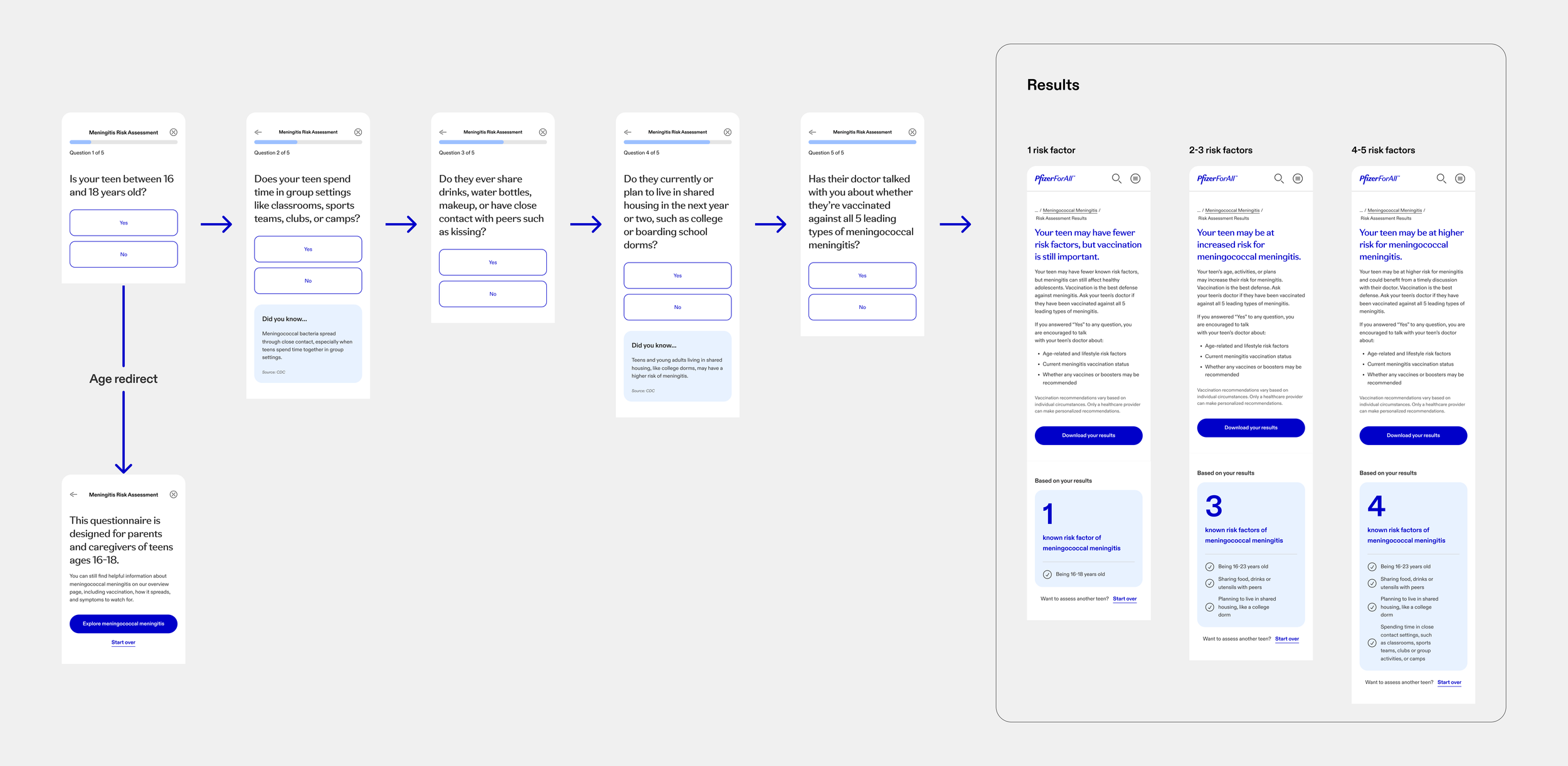
Midway through the sprint, Pfizer's medical team supplied the baseline questions for the risk assessment: five yes/no questions covering age (gated to 16–18 only), three questions dedicated to behavioral activities, and a final question asking whether a doctor had discussed vaccination status with the caregiver. The results page would then tally up the number of risk factors that were selected.
On review, we flagged three problems:
The questions felt obvious and leading rather than genuinely diagnostic
The vaccination question measured whether a conversation had happened with their doctor, not whether the teen was actually protected, which meant a caregiver could answer "yes" and still have no idea if their kid was covered
The 16–18 age gate excluded 19–23 year olds, who are also eligible for the MenB vaccine
To address these problems, I worked on an alternate risk assessment flow, aimed at reducing the amount of questions dedicated to behavioral activities and asking more direct questions about vaccination.
My first pass tried to make the quiz more actively educational about the coverage gap: I condensed all the activities into one multi-select question, and added a direct question asking which specific vaccine(s) the caregiver’s teen has received (MenB, MenACWY, MenABCWY, or unsure), with age subtitles telling caregivers when each vaccine is typically given. The results page would then show two results: how many risk factors that were selected, and how many types of meningitis they were protected against (based on the vaccines they selected).
The client's feedback was that this asked for more precision than most caregivers actually have - parents rarely know their kid's vaccine by product name, and even with an "I'm not sure" option, asking them to select from a specific list risked people abandoning the quiz rather than admitting they didn't know.
The final quiz mainly leans towards the original client-provided version, and focuses on Yes/No questions around behavioral activities that increase risk for teens and young adults. However, we made a few key changes to improve the quiz:
We widened the age range from 16-18 years old to 16-23 years old. We adjusted the first question to ask about age ranges, and added an option to select 19-23 years old. If a user clicks on that option, the language of the rest of the experience will be tailored towards that age range - all mentions of “teen” will be changed to “young adult,” and instead of telling caregivers to talk to their teen’s doctor, we’ll encourage caregivers to have their young adults talk to their own doctors.
We added an “I’m not sure” option to the kissing question and the vaccination question. If a user clicks on this option, it still counts as a risk factor within the assessment.
We adjusted the last question to directly ask caregivers whether their teen/young adult is vaccinated against all 5 leading types of meningococcal meningitis, instead of just asking whether their doctor has brought it up.
Challenge 2: Visualizing the 85% stat
”Nearly 85% of teens in the US are not fully vaccinated against all 5 leading types of meningococcal meningitis.”
It was important for us to include this statistic, since it’s the cornerstone of our messaging and it links directly to the risk assessment - so we sought out to visualize this stat in a way that’s both clear and eye-catching.
The "nearly 85% of teens aren't fully vaccinated" stat took more exploration than it looked like it should, because it's a negative, or "reverse," stat - it represents the percentage who aren't protected, not the percentage who are. The go-to option would be to represent 85% with dark blue and 15% with lighter blue, but by coloring the stat that way, it opens up risk for people to read it the wrong way around as 85% protected, the opposite of the intended message.
We explored a wide range of formats trying to solve this:
Pie and circle charts with a highlighted wedge
Vertical and horizontal bar graphs
Dot grids and icon arrays (rows of shaded figures)
Simple numeral + eyebrow callouts with no chart at all
Across all of them, the same color-encoding problem kept surfacing whenever we tried to differentiate "protected" from "unprotected" using only value (light vs. dark) within one color family. The actual fix was changing the encoding, not the chart type: introducing an orange accent color against the base blue, since orange reads as an alert color rather than
"more of the same thing but darker." That's what resolved the ambiguity - the final chart type (a horizontal bar of 20 individual lines, 17 of them filled in orange, paired with the 85% number and a "Vaccination gap" eyebrow label) was almost secondary once the color logic was fixed.
The Experience
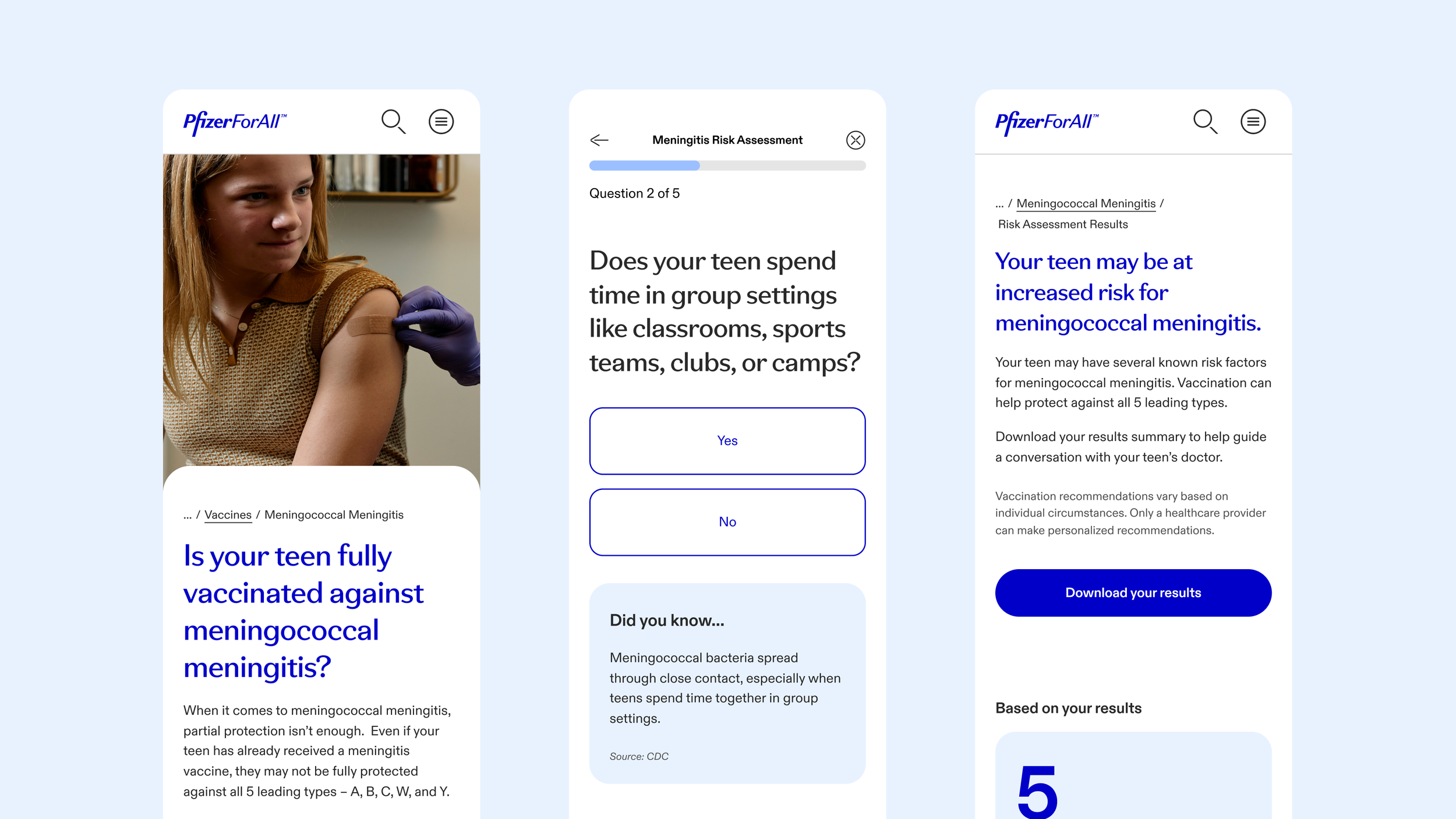
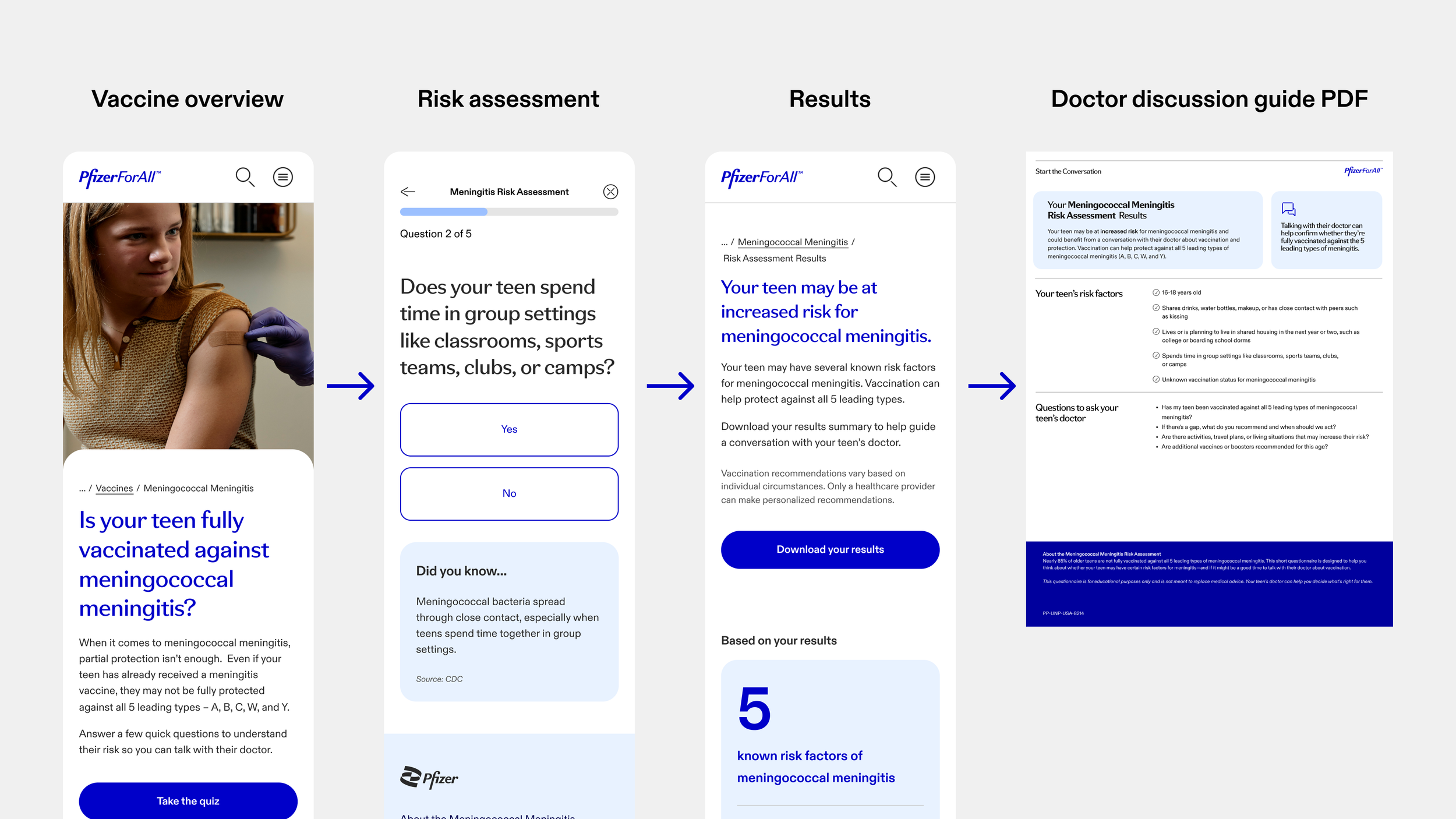
The final experience has four connected parts:
Reading through the vaccine overview page
Taking the risk assessment
Reading the risk assessment results page
Downloading the doctor discussion guide
Vaccine Overview
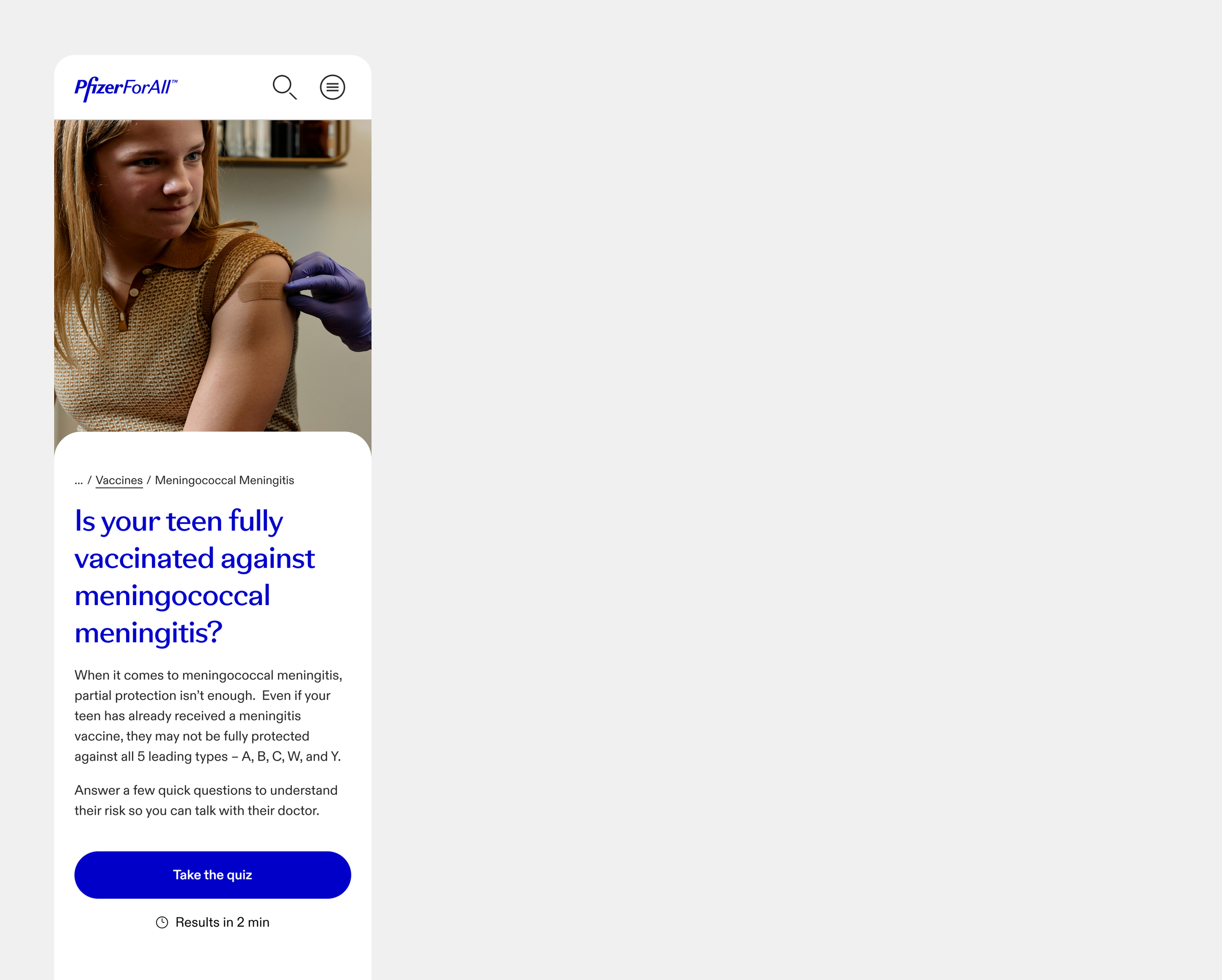
The page opens with: “Is your teen fully vaccinated against meningococcal meningitis? When it comes to meningococcal meningitis, partial protection isn’t enough. Even if your teen has already received a meningitis vaccine, they may not be fully protected against all leading types - A, B, C, W, and Y.”
From there, we have a CTA to the risk assessment page, as well as a “results in 2 minutes” label to show users that the risk assessment is quick and easy to fill out.
Below the hero section, the page is organized into digestible, expandable content blocks:
A “start with the basics” accordion block, giving basic information about the disease before talking about the vaccine. The first card is open by default, to emphasize to users that it’s a life-threatening condition, but we leave room for users to click on the remaining info they want, rather than overwhelming them with a wall of text and information at the start.
A callout stat, “About 1 in 4 US teens carry meningococcal bacteria,” reinforcing that asymptomatic spread is common.
Vaccine cards that educate the user on what the vaccines do, who they’re for, and possible side effects. We made sure to include that some vaccines only cover a few types of meningococcal bacteria, while others cover all five types.
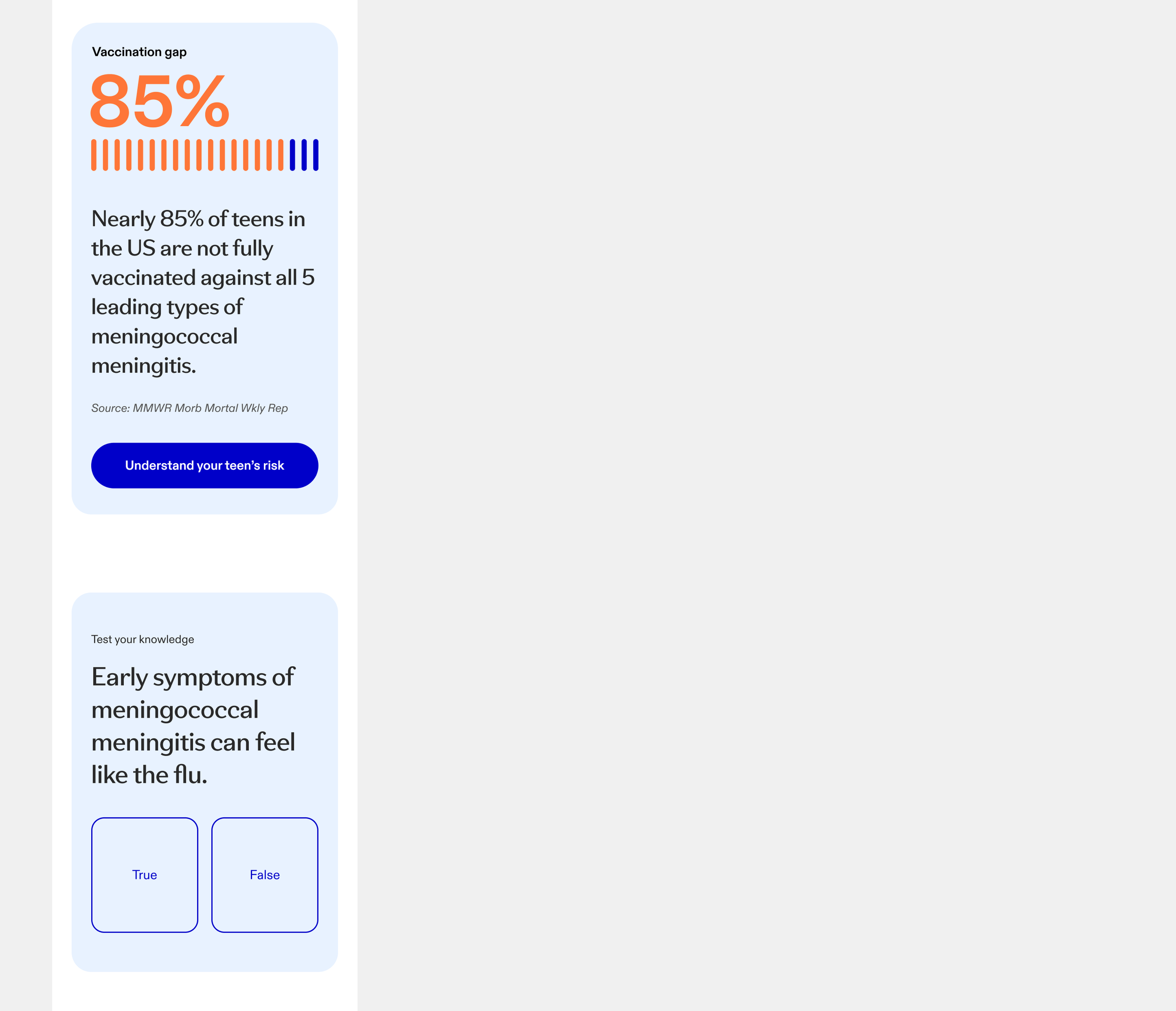
The 85%-of-teens vaccination-gap stat, used as the hook directly into the quiz
A True/False knowledge check ("Early symptoms of meningococcal meningitis can feel like the flu") that reinforces the "it's easy to miss" narrative and funnels into the quiz regardless of the answer given
An FAQ accordion addressing the questions caregivers actually have:
How to check a teen's existing vaccination records
What terms like "monovalent/quadrivalent/pentavalent" mean
Whether meningitis vaccines can be co-administered
What side effects to expect/how safe the vaccine is
All of the answers direct the user to talk to their teen’s doctor about their concerns, encouraging users to take the next step and take the risk assessment to download the doctor discussion guide.
A carousel of long-form articles about vaccines
2. Risk Assessment
The meningitis risk assessment is meant for caregivers of teens and young adults aged 16-23, who may have received a meningitis vaccine when they were 11, but may not have gotten full protection against all 5 leading types of meningococcal bacteria. By answering questions about behavioral risk factors (which apply to most teens and young adults), it shows the high risk of asymptomatic spread and the need to get vaccinated for all 5 types.
The first question asks for the age range of the caregiver’s teen or young adult. If the user clicks “Under 16” on the first question, they are redirected back to the overview page. If “16-18” is selected, the remaining questions will say “your teen,” and if “19-23” is selected, the remaining questions will say “your young adult”.
The next three questions ask about activities that their teen/young adult probably does, like spending time in group settings, sharing drinks/water bottles/makeup, kissing, and living in shared housing.
Each question includes a short “Did you know?” fact, so that caregivers learn about meningitis and how it spreads, even if they abandon the flow early.
The last question asks whether their teen/young adult is vaccinated against all 5 leading types of meningococcal meningitis. If the user selects “I’m not sure,” then that uncertainty counts as a risk factor.
3. Risk Assessment Results
Risk assessment results are scored 1-5 by number of risk factors selected:
Being 16-18 years old/19-23 years old
Spending time in group settings like classrooms, sports teams, clubs, or camps
Sharing food, drinks, or utensils with peers
Living or planning to live in shared housing, like a college dorm
Unknown vaccination status for meningococcal meningitis
Messaging is slightly different depending on how many risk factors are selected, but in all variations, users are encouraged to download their results to share with their teen’s/young adult’s doctor.
Only the hero messaging and the results block are dynamic - otherwise, the rest of the results page includes the following sections:
A secondary content module (“Preparing for a doctor conversation”) - once again encouraging the user to download their results
A callout stat - “97% of healthcare professionals who are parents make sure their teens are fully vaccinated against meningococcal meningitis.”
A featured article block that encourages users to learn more about how to talk to their healthcare provider(s) about vaccines
A CRM signup module to stay connected on vaccine news and information
4. Doctor Discussion Guide
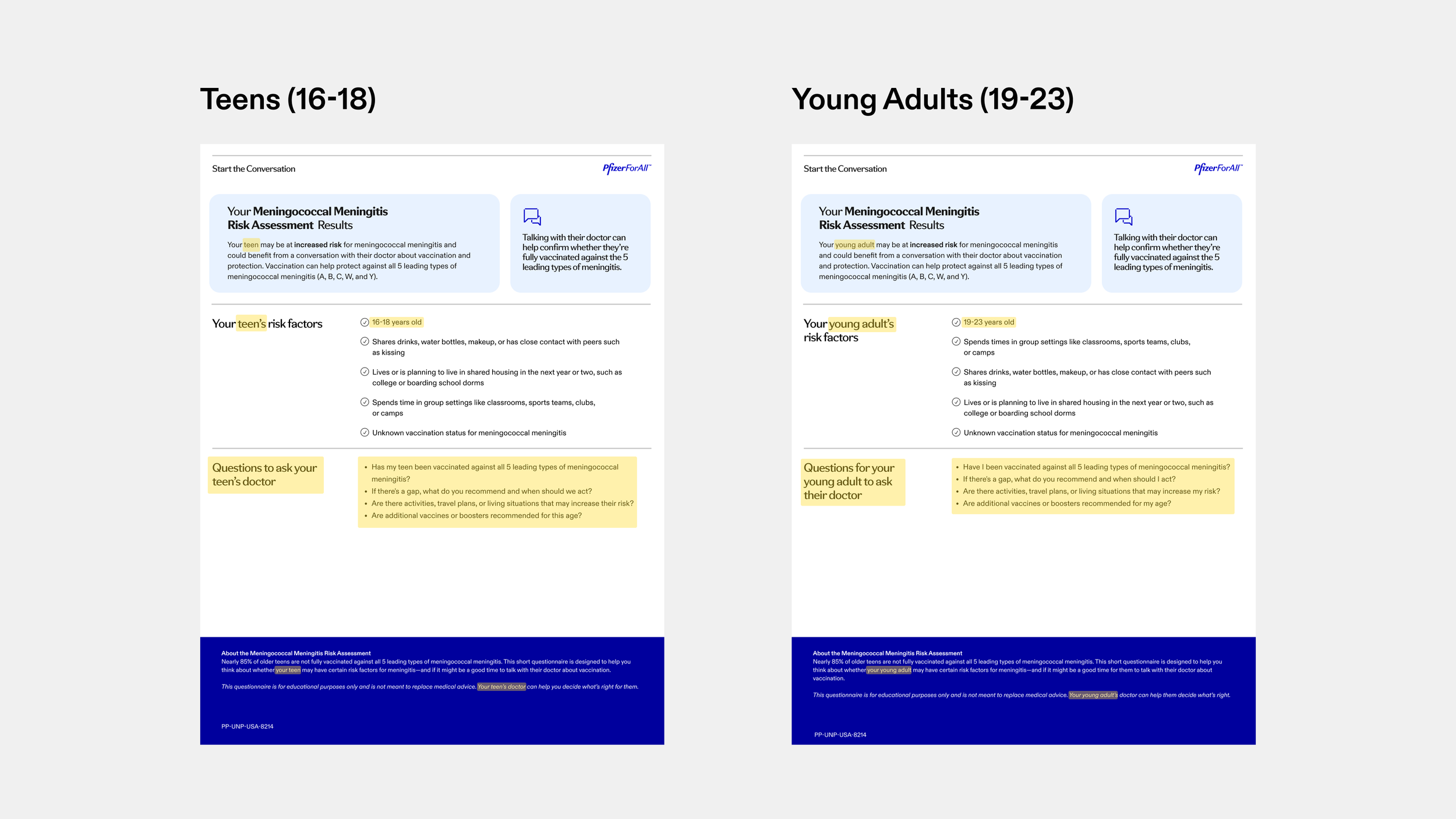
The doctor discussion guide is a PDF meant for caregivers/young adults to take with them to an appointment. Depending on which age range the user selected during the risk assessment, the language across the guide either says “teen” or “young adult,” and the young adult version encourages them to ask their doctor.
The discussion guide contains the following:
A summary of the risk assessment results
A checklist of all the risk factors that were selected
A list of questions to ask their doctor
Takeaways
Success Metrics (goals defined before launch)
The project shipped against the following targets, defined before launch:
| Objective | KPI | Goal |
|---|---|---|
| Increase awareness of meningitis vaccine availability among caregivers | Engaged Session Rate | 32.6% |
| Risk Assessment Start Rate (from landing page) | 6.5% | |
| Drive caregivers to ask their teen's doctor about complete vaccination | Risk Assessment Completion Rate | 27.6% |
| Discussion Guide Download/Email Rate | 15.0% | |
| High-Value Action (HVA) Rate | 2.5% |
Note: I haven’t received post-launch performance data yet, but if that changes, I will update this section with a new column.
Reflection
During my six months working on PfizerForAll, I primarily worked on optimizations on existing pages, so getting to work on a new Treatment Area page was exciting and rewarding. It proved to be a unique challenge unlike any of the other vaccine pages - instead of encouraging adult users to book a vaccine for themselves, our main goal was to educate caregivers and drive them to start a conversation with their teen’s doctor about vaccination, so we had to adjust our usual content strategy to respond to that.
Working with strategy and copy on messaging of the overview page taught me a lot about the nuances of educating about a medical condition - it’s tricky to be conversational without being misleading, and informative without being too scary. Staying in the confines of medical/legal guardrails is a challenge, but ultimately I believe we were able to get that balance just right.